Showing posts with label DERMATITIS. Show all posts

Saturday, July 22, 2017

WINTER RELATED ATOPIC DERMATITIS VITAMIN D HELPS


A study conducted in more than 100 Mongolian schoolchildren found that daily treatment with a vitamin D supplement significantly reduced the symptoms of winter-related atopic dermatitis, a type of eczema. Led by a Massachusetts General Hospital (MGH) physician, the report in the October issue of the Journal of Allergy and Clinical Immunology supports the results of a preliminary study that showed similar results in a small group of children in Boston

While we don't know the exact proportion of patients with atopic dermatitis whose symptoms worsen in the winter, the problem is common," says Carlos Camargo, MD, DrPH, MGH Department of Emergency Medicine. "In this large group of patients, who probably had low levels of vitamin D, taking daily vitamin D supplements -- which are inexpensive, safe and widely available -- proved to be quite helpful." Camargo led both the earlier Boston pilot study and the current investigation, which was performed in collaboration with investigators from the Health Sciences University of Mongolia.
A chronic inflammatory disorder of the skin, atopic dermatitis is uncomfortable and makes patients more vulnerable to bacterial infection. Symptoms of the disorder -- most commonly seen in children -- often worsen during wintertime. While controlled administration of ultraviolet light, which can stimulate the production of vitamin D in the skin, is a common treatment for severe atopic dermatitis, the possibility that vitamin D deficiency contributes to the seasonal worsening of symptoms had received little consideration prior to the Boston study. That investigation involved only 11 children but provided preliminary support for the hypothesis.
The current study, conducted in collaboration with the National Dermatology Center in Mongolia, enrolled 107 children, ages 2 to 17, from nine outpatient clinics in the capital city of Ulaanbaatar. The participants -- all of whom had a history of atopic dermatitis symptoms worsening either during cold weather or around the transition from autumn to winter -- were randomly divided into two groups. One group received a daily vitamin D dose of 1000 IU while the other received a placebo -- both delivered in odorless, colorless and tasteless drops. Neither the children's parents nor the study investigators knew to which group participants had been assigned.
Standard evaluations of atopic dermatitis symptoms were conducted at the outset of the trial and at the end of the month-long study period, and parents were also asked whether they saw any improvement in their child's condition. At the end of the month, children receiving the vitamin D supplement had an average 29 percent improvement on the primary assessment tool used, compared with 16 percent improvement in the placebo group. Additional assessments -- including the report from parents -- also showed significantly greater improvement among children receiving vitamin D.
While data gathered at the outset of the study could not determine whether or not participating children were deficient in vitamin D, the authors note that an even larger study of Ulaanbaatar children conducted at the same time found significant vitamin D deficiency in 98 percent of participants, supporting the probability that the children in this study were also deficient. While future studies are needed to assess the value of vitamin D treatment in adults and in children with year-round symptoms, Camargo -- a professor of Medicine at Harvard Medical School -- says that parents of children with symptoms that worsen in the winter should try a vitamin D supplement for a few weeks when symptoms flare to see if it helps. He encourages parents to discuss this study and their plan with their primary care provider.

Monday, July 10, 2017

HOMOEOPATHIC REMEDIES FOR SEBORRHEIC DERMATITIS


Seborrheic  dermatitis is a common skin condition that mainly affects your scalp. It causes scaly patches, red skin and stubborn dandruff. Seborrheic dermatitis can also affect oily areas of the body, such as the face, upper chest and back.
Seborrheic dermatitis doesn't affect your overall health, but it can be uncomfortable and cause embarrassment. It isn't contagious, and it's not a sign of poor personal hygiene.
Seborrheic dermatitis is usually a long-term condition. You may need many repeated treatments before the symptoms go away. And they may return later. You may be able to manage flare-ups by recognizing seborrheic dermatitis symptoms and using a combination of self-care steps and medications.
Causes-Doctors don't yet know the exact cause of seborrheic dermatitis. But it may be related to:
·         A yeast (fungus) called malassezia that is in the oil secretion on the skin
·         An inflammatory response related to psoriasis
·         The season, with episodes tending to be worse in early spring and winter

Symptoms--Seborrheic dermatitis symptoms include:
·         Skin flakes (dandruff) on your scalp, hair, eyebrows, beard or mustache
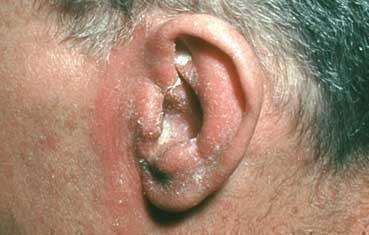
·         Patches of greasy skin covered with flaky white or yellow scales or crust on the scalp, ears, face, chest, armpits, scrotum or other parts of the body
·         Red skin
·         Redness or crusting of the eyelids (blepharitis)
·         Possibly itching or stinging

Risk factors-A number of factors increase your risk of developing seborrheic dermatitis, including:
·         Neurological and psychiatric conditions, such as Parkinson's disease and depression
·        A weakened immune system, such as seen in organ transplant recipients and people with HIV/AIDS, alcoholic pancreatitis and some cancers
·         Congestive heart failure
·         Endocrine disease that leads to obesity, such as diabetes
·         Some medications
·         Scratching or otherwise damaging the skin on your face

HOMOEOPATHIC REMEDIES
ARSENIC ALBUM 30-Arsenic album is an effective remedy for seborrheic dermatitis in weak persons.It is also suited patients with fair skin.  The scalp is covered with white scales which itch intolerably.Circular patches on bare spots are seen. Along with this great anxiety and restlessness is present.
KALI SULHURICUM 30- Kali sulphuricum is one of the top remedies for seborrheic dermatitis with yellow scales.  There is  prominent yellow flakes on the scalp. The scales are sticky in nature, with a moist scalp. Also it  is attended with itching. Heat worsens the itching .

THUJA OCCIDENTALIS 200-Thuja occ. is another effective medicine for seborrheic dermatitis with white flakes on the scalp.   The other prescribing points are dry hair, which may be split at ends and falling of hair. The hair may be dry in such cases.

CALCAREA SULPH 30-Calcarea sulph. is prescribed for  seborrheic dermatitis when eruptions with yellow pus occurs. Falling of hair also occurs.

GRAPHITES 30-Graphites  is an effective  Homeopathic medicine for seborrheic dermatitis where the scales on the scalp are accompanied by intense itching. The scales reduce after washing, but reappear. A fetid odour on the scalp may also be observed. The scalp may also remain moist and humid. Matting together of the hair or falling of hair are also seen. Apart from the scalp, the scales may also be present on the eyelid margins and behind the ears.
 
NATRUM MURIATICUM 30- Natrum Muriaticum is prescribed for seborrheic dermatitis with a greasy, oily scalp with redness and flakiness. The scalp is covered with white scurfs. Burning sensation on the scalp may also be present. The face is oily, with redness. Acne on the face may also be present along with the above symptoms.

PHOSPHORUS 30--Phosphorus  is prescribed when  flakiness on the scalp is attended with excessive hairfall is occurs.  The hair fall in bunches. In some cases, the hair may fall off in spots. This may be accompanied by a severe burning sensation on the scalp. In a few cases, clammy sweat on the scalp may also be present.

SANICULA AQUA 200- Sanicula is another effective remedy for seborrheic dermatitis. Scales are covering the scalp. Scales are also seen on the eyebrows, eye lashes etc. Profuse sweat is present on the head.

MEZEREUM 30-Mezereum is one of the best remedies for seborrheic dermatitis. Scalp covered with scaly eruption with white scabs. Head covered with thick, leathery, crusts, under which pus collects. 

PSORINUM 200-Psorinum is suited to humid seborrheic dermatitis on the scalp which smells badly. Intolerable itching is present.

SULPHUR 200- Sulphur is prescribed when well selected remedies fail. Intolerable itching and scratching of scalp. Scratching causes severe burning.


For more details refer my book—Diseases of skin with Homoeopathic management.